Powder Coating vs Liquid Painting Lines: Pretreatment, Curing Ovens, Quality Tests and Exhaust Treatment

By Longen Automation (Jiangxi Longen Automation Equipment Co., Ltd.) – manufacturer of powder coating lines, spray painting lines, e-coat (electrophoresis) lines and waste gas treatment systems since 2012, Yichun, China.
Short answer: Coating quality is decided before the paint gun and after it. Most adhesion and corrosion failures come from poor pretreatment or under-curing, not from the powder or paint itself. Choose the process (powder or liquid) from the substrate, finish and output, then design pretreatment for the metal, size the oven from the coating's cure schedule and the line speed, verify with standard tests, and treat exhaust according to what the process actually emits.
1. Powder coating line or liquid painting line – which should a factory choose?
| Powder coating line | Liquid (wet) painting line | |
|---|---|---|
| Typical substrates | Steel, aluminium, galvanized steel – conductive parts that tolerate oven temperatures | Almost any substrate, including plastics, wood, composites and heat-sensitive assemblies |
| Film | Thicker single coat (commonly 60–120 µm), very durable | Thinner coats, often primer + topcoat; very smooth high-gloss finishes are easier |
| Material use | Overspray can be recovered and reused; high transfer efficiency | Overspray is waste unless electrostatic or robotic application is used |
| VOC emissions | Practically none from the coating | Solvent-borne paints emit VOCs and need exhaust treatment (water-borne paints reduce this) |
| Colour change | Slower; separate booth or recovery system per colour for high-volume colours | Faster, flexible for many colours and small batches |
| Curing | Oven required, typically around 160–200 °C metal temperature | Air dry, low-temperature bake or high-temperature bake depending on paint |
| Typical products | Metal furniture, shelving, appliances, aluminium profiles, enclosures, auto parts, agricultural equipment | Plastics, large or heat-sensitive parts, high-gloss or multi-layer decorative finishes |
Decision guide: choose powder for metal parts, long production runs in a limited number of colours, strict VOC rules and durability requirements. Choose liquid for non-metal or heat-sensitive substrates, very frequent colour changes, very thin or very high-gloss finishes. Many factories combine an e-coat (electrophoresis) primer with a powder or liquid topcoat for maximum corrosion resistance.
2. What pretreatment is needed before coating steel, aluminium and galvanized parts?
Pretreatment removes oil, rust and oxides and creates a conversion layer that the coating bonds to. A typical spray or dip line has these stages, each followed by rinsing:
| Substrate | Typical sequence | Key points |
|---|---|---|
| Cold-rolled / hot-rolled steel | Degrease (alkaline) → rinse → pickling / derusting if rust or scale → rinse → surface conditioning → zinc or iron phosphate, or zirconium-based conversion → rinse → DI water rinse → dry-off oven | Heavy scale or laser-cut edges may need shot blasting; dry immediately to avoid flash rust |
| Aluminium | Alkaline or acid clean → rinse → deoxidize → rinse → chrome-free conversion (zirconium/titanium) → rinse → DI water rinse → dry | Remove the natural oxide; for architectural aluminium follow the specification the customer requires (e.g. Qualicoat/AAMA) |
| Galvanized steel | Mild alkaline clean → rinse → light etch or sweep blast if needed → conversion coating → rinse → DI rinse → dry | Strong alkali attacks zinc; pre-heat (outgassing) before powder reduces pinholes |
| Mixed metals on one line | Use a multi-metal (usually zirconium-based) chemistry and control it for the most sensitive metal | Confirm with the chemical supplier |
Process control: check bath concentration, temperature, pH and conductivity daily; keep the final rinse conductivity low (DI water); log results. Most "powder falls off" complaints trace back to an uncontrolled degreasing bath or contaminated final rinse.
3. How are the temperature profile, dwell time and size of a powder curing oven determined?
- Start from the powder's technical data sheet, which gives the cure schedule as metal (substrate) temperature and time, for example 180 °C for 10 minutes or 200 °C for 8 minutes. Air temperature is not the same as part temperature.
- Add heat-up time. Thick or heavy parts take longer to reach cure temperature than thin sheet. Measure with a data-logging oven profiler on the heaviest part.
- Total dwell time = heat-up time + cure time at metal temperature (plus a safety margin).
- Oven conveyor length = line speed × total dwell time. Example: line speed 2 m/min and 25 min dwell → 50 m of conveyor inside the oven, arranged in passes (U-turns) to keep the oven compact.
- Cross-section comes from the largest part envelope plus clearance.
- Heat load includes the parts, hangers and conveyor chain entering each hour, wall losses and exhaust air. This sizes the burner or heaters (gas, diesel, electric or biomass, depending on local energy prices and regulations).
- Uniformity: specify the allowed temperature variation across the oven and verify it at commissioning with a profiler.
4. Which tests verify coating thickness, adhesion, cure and corrosion resistance?
| Property | Common test method | When |
|---|---|---|
| Dry film thickness | Magnetic/eddy-current gauge – ISO 2808, ASTM D7091 | Every shift, several points per part |
| Adhesion | Cross-cut test – ISO 2409 / ASTM D3359 | Daily and after any pretreatment change |
| Degree of cure | Solvent rub test (e.g. MEK rubs) per powder supplier's method | Daily, and when changing parts or line speed |
| Impact / flexibility | Impact test – ASTM D2794 or ISO 6272; mandrel bend – ISO 1519 | Per batch or agreed frequency |
| Gloss and colour | Gloss meter – ISO 2813; colorimeter vs. master panel | Per batch |
| Corrosion resistance | Neutral salt spray – ISO 9227 / ASTM B117 (hours per customer spec) | Qualification and periodic audit |
| Appearance | Visual inspection under standard light for orange peel, pinholes, craters, runs | Continuous |
Record results against batch, line speed and oven profile so defects can be traced. Typical defects and causes: poor adhesion – pretreatment; soft film / poor solvent resistance – under-cure; yellowing – over-cure; pinholes on galvanized or castings – outgassing.
5. How should exhaust collection and treatment be configured for painting and powder coating lines?
The treatment depends on what each source emits:
- Powder booths emit powder particles, not solvents. Use cartridge or cyclone + cartridge recovery to reuse powder and filter the exhaust; design for explosion protection (powder concentration limits, grounding, flame detection where required).
- Liquid spray booths emit paint particles and VOCs. First remove particles (dry filters or a water curtain), then treat VOCs.
- Flash-off zones and paint drying ovens emit concentrated solvent vapour – often the best stream to treat.
- Curing ovens and burners emit combustion gases; powder ovens emit small amounts of cure by-products.
Typical VOC treatment options:
| Option | Fits |
|---|---|
| Activated carbon adsorption + desorption + catalytic oxidation (CO) | Large air volume, low concentration – common for spray booths |
| Regenerative thermal oxidizer (RTO) | High air volume with moderate to high concentration; high destruction efficiency |
| Zeolite rotor concentrator + RTO/CO | Very large air volume, low concentration |
| Direct catalytic oxidation | Small, concentrated streams such as drying ovens |
Design steps: list every emission source → calculate exhaust air volume per source (booth face velocity × opening area) → estimate VOC load from paint consumption and solvent content → choose treatment → check the local emission limits and monitoring requirements in the destination country.
How Longen Automation can help
Longen has built complete coating lines since 2012, and our equipment is installed in South Korea, Indonesia, Vietnam and Egypt. The range covers:
- LE-LS ovens and drying/curing tunnels with a choice of heat source – electricity, natural gas, diesel, coal or biomass pellets – hot-air circulation and constant-temperature control.
- LE-SP spray booths: water-curtain paint booths (water curtain, air-water separation and filtration before exhaust) and powder booths with cartridge filters and pulse back-blowing recovery.
- LE-DK automatic electrostatic spray chambers with rotary-disc bells, high-voltage generators, paint supply, and fire and explosion protection devices.
- LE-CT electrophoresis (e-coat) lines with pretreatment spray cabinets, cathodic e-coat tank, ultrafiltration, post-rinse, drying, and an optional wastewater treatment station; plus electroplating lines.
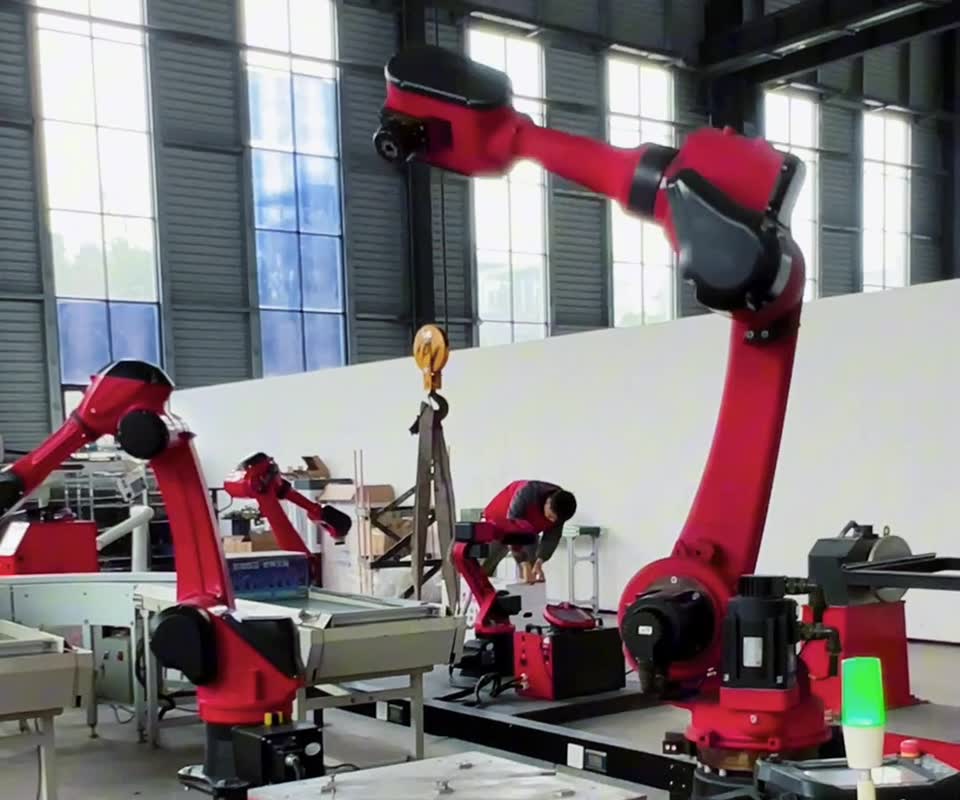
- Conveyors for coating lines: LE-QXG and LE-XT suspension conveyors, LE-QD floor-track lines and LE-XC trolley lines; UV curing machines (LE-QG); and BORUNTE spraying robots such as the BRTIRSE2013A (13 kg, 2,000 mm reach, IP65 body).
Typical industries: hardware and electromechanical products, electronics, communication equipment, household appliances, automotive parts and plastics.
Send your part drawings, materials, target output and finish specification for a free engineering review: WhatsApp / phone +86 133 2005 6136, email Sales001@lezdh.com.
Choosing and Designing Industrial Conveyor Systems: Speed Chain, Belt, Roller, Telescopic and Intelligent Logistics Lines
How to Specify an Industrial Robot Cell: Robot Type, Payload, Grippers, Accuracy, IP Rating and Safety
Related Article